
Workshop review
Bambu Lab AMS: worth buying? The case for convenience—not colour.
Bambu Lab’s four-spool feeder can produce colour prints and use a dedicated support material. Its more persuasive talent is making ordinary single-material printing much less fussy.
4filaments ready at once
16filaments with four AMS units
1hot end doing the switching
The short verdict
Buy it for a calmer workflow. Treat multicolour as a bonus.
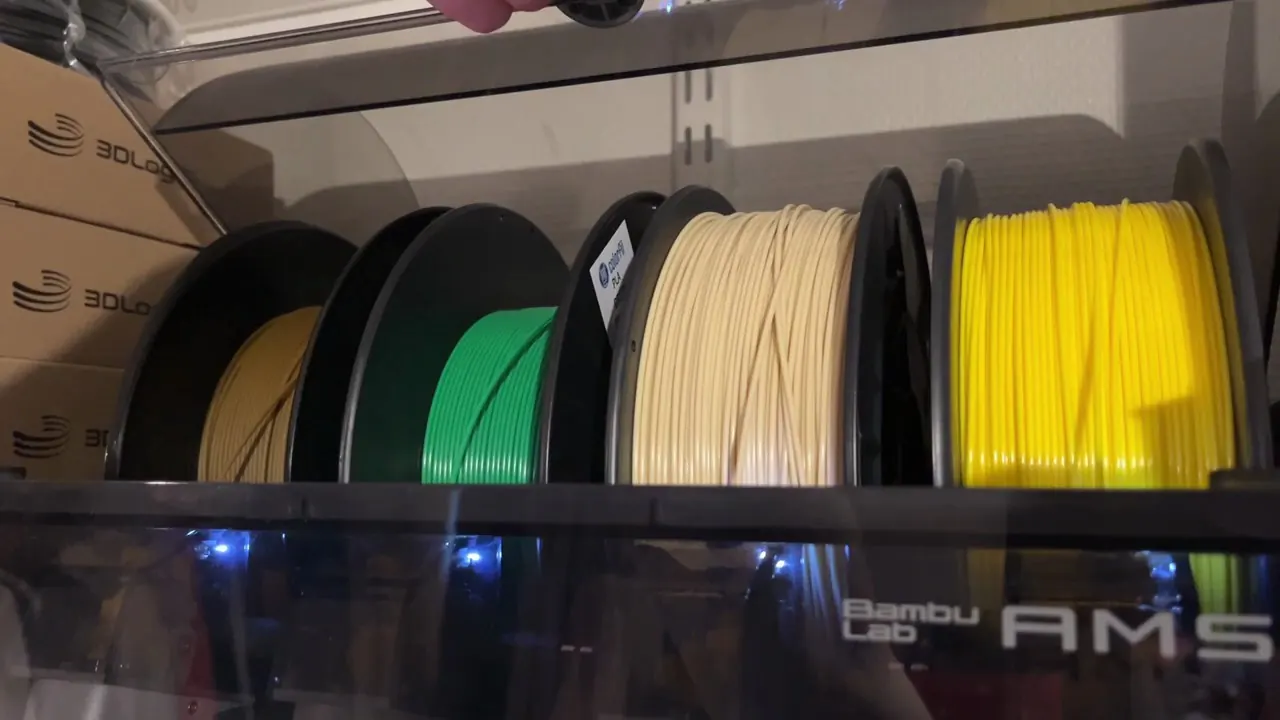
The AMS is easy to mistake for a colour-printing accessory. It certainly is one: load four spools, assign colours in the slicer and the printer handles the changes. But after the novelty has worn off, its best work is quieter. It keeps the materials you use most within reach, changes over without a trip to the rear spool holder, and can move to a matching replacement spool when one runs out.
That convenience is especially valuable on a printer such as the Bambu Lab P1P, where the simple alternative is repeatedly unloading and loading filament by hand. It is not indispensable, and it is expensive as a separate add-on. For the right workshop, though, it is the upgrade that changes the rhythm of using the printer.
Makers who regularly rotate among PLA, PETG and support material, or who want a long print to survive an empty spool without a late-night intervention.
Everyday utility
Four loaded spools solve a surprisingly mundane problem.
Most print jobs are not rainbow dragons. They are black brackets, white housings, a roll of PETG for the parts that need it, and perhaps a support interface material for the occasional awkward model. With an AMS, those choices are made at the computer. Pick the slot in Bambu Studio; the feeder takes care of the rest.
Automatic runout switching is even more useful. Put two rolls of the same filament in the unit and the printer can continue onto the second when the first is empty. That makes the final 20 or 50 grams on a spool usable rather than a small, accumulating collection of almost-enough filament. It is a modest feature on paper and a genuinely practical one over time.
Multicolour reality
It works well—but one nozzle makes colour expensive.
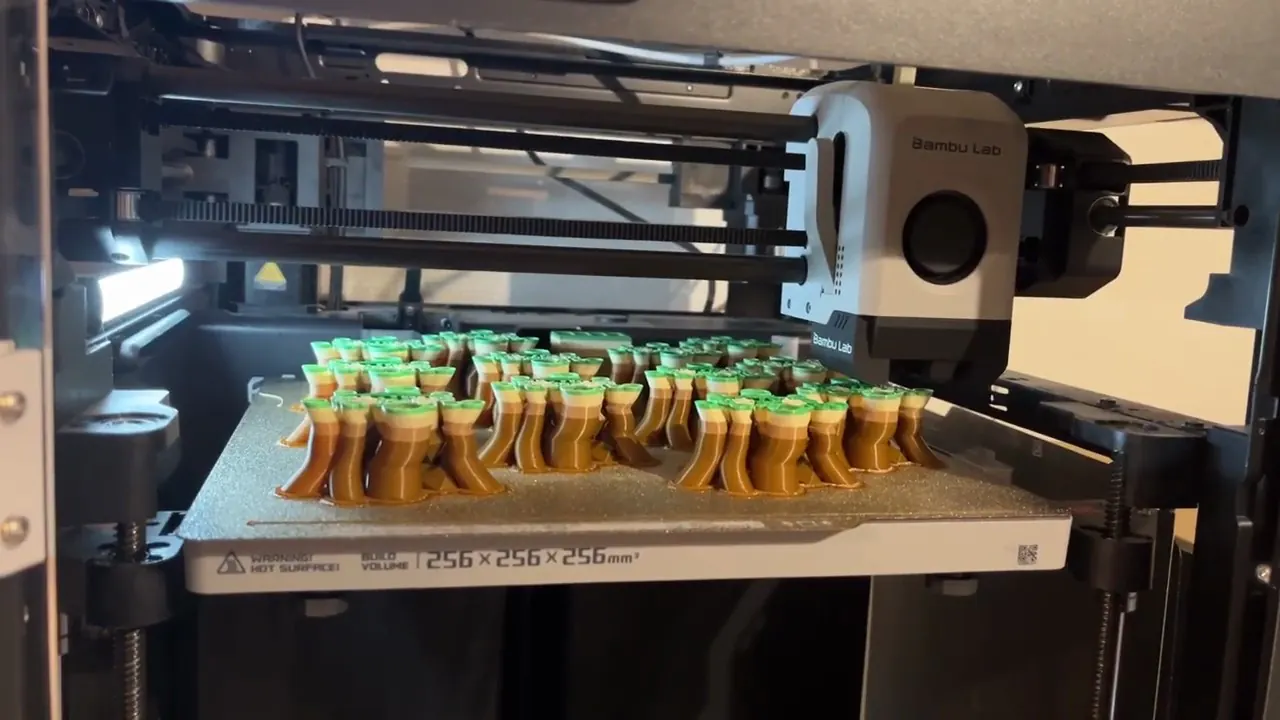
The AMS does not give a P1P four independent print heads. There is still one nozzle, so every colour change means unloading, loading and purging filament before the print resumes. On a modestly coloured model this is tolerable. On a complex object with frequent changes, the waiting and waste can dwarf the part itself.
The same compromise applies to dedicated support material. A soluble or easy-release interface can make supports come away beautifully, particularly from difficult geometry, but the printer pays for each transition in time and discarded plastic. It is a useful selective tool, not a reason to turn every job into a multi-material production.
Fit and reliability
It rewards ordinary spools and ordinary filaments.
Spool shape matters
Standard one-kilogram spools are the safe choice. A roll that is unusually wide can foul the mechanism, so a new brand is worth checking before it becomes part of a long unattended job.
Soft and abrasive filaments do not belong here
The long PTFE path and feeder force make flexible TPU a poor match. Carbon- and glass-fibre filaments are also better fed directly, rather than asking the AMS drive gears to wear through abrasive material.
Convenience still needs a check
An occasional spool can stick or fail to feed cleanly. It is not a reason to avoid the system, but it is enough reason to watch the start of a 40-hour print.
Final word
Best bought with the printer—and best used for the unglamorous jobs.
At the review price of $349 when purchased separately, the AMS is difficult to call an automatic bargain. It makes more financial sense in a bundle, especially if the printer is already part of a busy hobby or workshop routine. If you seldom change material and do not care about runout switching, spend the money elsewhere.
If elaborate multicolour models are the main ambition, a true tool-changer or IDEX machine is a better answer: it avoids much of the time and purge waste inherent in one-nozzle swapping. For everyone else, the AMS earns its place through the prosaic wins: the right spool is ready, the part keeps printing, and a printer becomes a little less demanding to live with.
Read the P1P long-term review