
Workshop guide
3D printer filaments explained: the right plastic for the job.
There is no universally best filament. There is only the material that fits the part, the environment it will live in and the printer that has to make it. Start there, and the shelf of spools becomes a useful toolkit instead of an expensive guessing game.
3everyday materials to know
2questions before buying a spool
1rule: dry plastic prints better
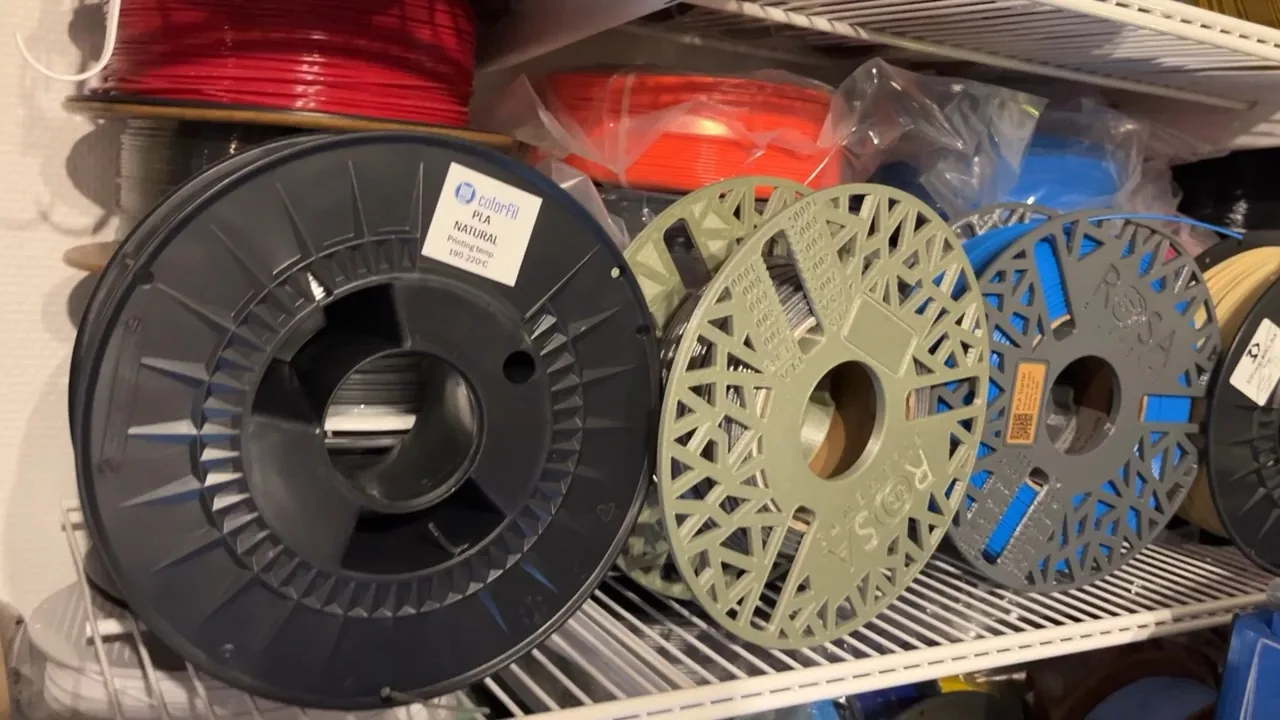
Start with the job
Ask what the part must survive—not what filament is popular.
A display model, a garden bracket and a flexible phone bumper may all begin as an STL file, but they should not begin with the same spool. The useful first question is whether the part needs to stay rigid, bend, live outside, tolerate heat or take a knock. The second is whether the printer can supply the temperature, enclosure, ventilation and dry filament that the material asks for.
For most work, the answer is reassuringly ordinary. PLA, PETG and TPU cover a vast amount of making. The engineering materials make sense when a job truly needs their heat resistance, toughness or stiffness—not simply because their names sound more serious.
The everyday shelf
PLA, PETG and TPU: three different kinds of useful.
PLA: the easy default
PLA is affordable, quick to print and an excellent place to begin. Around 190–220°C at the nozzle and a 50–60°C bed usually gives clean decorative pieces, toys and prototypes. It is hard rather than tough: it snaps before it bends, softens around 60°C and is a poor choice for long-term outdoor use.
PETG and PCTG: functional without drama
PETG is the sensible step up for brackets, containers and outdoor parts. It is tougher than PLA, handles roughly 80°C and resists UV better, while remaining relatively easy to print at around 230–250°C. PCTG is the more impact-resistant, slightly more forgiving cousin when PETG’s stringing becomes tiresome.
TPU: for parts that must flex
TPU is rubbery, tough and difficult to snap—ideal for feet, gaskets, bumpers and protective cases. It likes a slow 20–40 mm/s pace and a direct-drive extruder. Its flexibility trades away some dimensional precision, which is exactly the right compromise for a part designed to bend.
Heat, weather and outdoors
Choose ASA for sun. Choose ABS only when its particular strengths matter.
ABS remains tough, impact-resistant and useful up to roughly 100°C, but it earns its reputation as a demanding material. It needs a 240–270°C nozzle, a hot bed, an enclosure to control warping and proper ventilation for its fumes. It is not a logical first material just because it is familiar.
ASA asks for much the same printing environment but brings the advantage that usually matters outside: UV and weather resistance. For a garden fitting, vehicle accessory or part that will spend its life in sunlight, ASA is the more durable choice. Fibre-filled ABS and ASA blends add stiffness and reduce warping, but their abrasive fibres demand a hardened nozzle.
When ordinary plastic is not enough
Nylon, PC and PPS have a real job to do. Give them the right machine.
Nylon is strong, impact-resistant and slightly flexible—excellent for gears, hinges and parts that work under pressure. It also pulls moisture from the air aggressively. A wet spool prints badly, so drying around 80°C for ten hours or more is part of using it, not optional preparation.
Polycarbonate takes the requirements further: a hot end above 260°C, a 100–120°C bed, enclosure, excellent bed adhesion and thoroughly dry filament. The reward is a strong, high-temperature material suitable for mechanical pieces. PPS is another step again: an industrial polymer for chemical resistance and sustained high temperatures. It requires extreme print conditions and belongs on a specialist printer, not a beginner’s shopping list.
The habits that save prints
Moisture and abrasion are the two problems most people underestimate.
Nearly every material benefits from being dry; the difference is how urgently it needs it. PLA can usually recover with a few hours around 45°C. PETG, PCTG and TPU are happier after a few hours around 50°C. ABS and ASA benefit from longer, warmer drying, while nylon, PC and PPS demand proper planning. Popping, stringing, dull surfaces and weak layer adhesion are often a wet-spool problem before they are a slicer problem.
The other check is the nozzle. Carbon- and glass-fibre blends are abrasive: standard brass wears quickly, changing the nozzle’s diameter and the print along with it. Use hardened steel or ruby for fibre-filled materials. Then select filament for the part’s actual job, keep it dry and let the printer’s material limits make the final call.
Keep PLA for easy prototypes, PETG for most functional parts, and TPU for anything flexible. Add ASA or a true engineering material only when the part’s environment makes it necessary.